Crossing the Border for Value: Why English Firms Are Turning to Welsh Professional Services

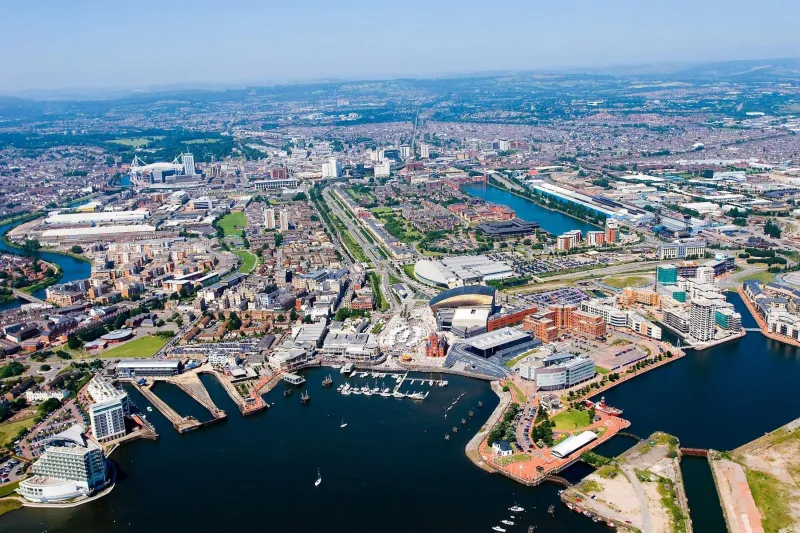
Photo: Sprague, John Franklin., No restrictions, via Wikimedia Commons
A Quiet Shift in the UK's Professional Services Landscape
For decades, the instinct among English businesses seeking specialist professional support has been to look eastward — towards London, Manchester, or Birmingham. Yet a growing number of UK firms are finding that some of their most capable and cost-effective partners sit on the other side of the Severn Bridge. Welsh professional services companies, long underestimated outside their own borders, are steadily building reputations that extend well beyond Wales.
The trend is visible across disciplines. Accountancy firms in Cardiff are auditing the books of mid-sized English manufacturers. Legal practices in Newport are advising technology start-ups in the Midlands. Marketing consultancies in Swansea are running integrated campaigns for retail brands headquartered in Bristol and beyond. The common thread is a compelling proposition: expertise that rivals the best in the UK, delivered at rates that reflect the realities of operating outside the South East of England.
The Cost Arithmetic That Drives Decisions
The financial case is straightforward, even if it is rarely discussed openly. Office space in central Cardiff costs a fraction of equivalent premises in London. Salaries for experienced professionals, whilst competitive by Welsh standards, sit measurably below those commanded in major English cities. These structural savings allow Welsh firms to price competitively without compressing their margins — and without compromising on the calibre of staff they attract and retain.
Consider the numbers in broad terms. A mid-tier management consultancy operating from Cardiff can deliver a comparable brief to a London counterpart at a day rate that may be 25 to 40 per cent lower, depending on the specialism and seniority involved. For a business commissioning a substantial project — a strategic review, a legal due diligence exercise, a year-long marketing retainer — those differences compound into significant savings across a financial year.
Crucially, Welsh firms are not competing on price alone. The professionals staffing these businesses are frequently trained to the same standards as their counterparts anywhere in the UK. Many hold qualifications from the same institutions, have worked in London or internationally earlier in their careers, and have chosen Wales for lifestyle or family reasons rather than professional limitation. The result is a talent pool that is both experienced and, in many cases, deeply motivated to demonstrate its worth.
Case Studies: Welsh Firms Landing Cross-Border Contracts
One Cardiff-based accountancy practice, established for over two decades, has in recent years expanded its client base substantially into the West of England and the East Midlands. The firm's managing partner describes a pattern that has become familiar: an initial enquiry driven by a recommendation, a competitive pitch process, and then — once the relationship is established — a broadening scope of work as the client's confidence grows. "We are not the cheapest option they find," the partner notes, "but we are consistently the best value. Those are different things."
In the legal sector, a Newport firm specialising in commercial property and corporate transactions has built a client roster that includes several English property developers and a number of technology businesses seeking transactional legal support. The firm's approach has been to invest heavily in sector expertise rather than geographic marketing, allowing its reputation to travel through professional networks rather than advertising spend.
The marketing and creative sector tells a similar story. A Swansea-based agency with specialisms in digital strategy and brand development has secured retainers with clients in the retail and hospitality sectors, some of whom are based as far away as the North of England. The agency's founder is candid about the advantage Wales provides: "Our overheads mean we can afford to staff projects properly and still come in below what a comparable London agency would charge. That gives us room to do the work well."
What Welsh Firms Offer Beyond Price
To reduce this phenomenon purely to cost would be to misread it. English businesses that have engaged Welsh professional services firms frequently cite qualities that have nothing to do with the invoice. Responsiveness is mentioned often — the sense that a Welsh firm, perhaps managing a smaller portfolio of retained clients, is more genuinely attentive than a larger practice might be. Partner-level involvement is another recurring theme; the principal who pitched for the business is often the same individual delivering it.
There is also a cultural dimension that deserves acknowledgement. Welsh professionals tend to bring a directness and practicality to client relationships that some businesses find refreshing after experiences with more hierarchical or process-heavy firms. This is, of course, a generalisation — but it surfaces consistently enough in conversations with clients to be worth noting.
The devolved policy environment in Wales has also created pockets of genuine specialism. Firms that have developed expertise in navigating Welsh Government procurement frameworks, understanding the Welsh planning system, or working within the particular regulatory landscape of Welsh public sector contracts bring knowledge that is genuinely difficult to replicate from outside the country.
The Infrastructure Supporting Growth
Wales's professional services sector is not operating in isolation. The Welsh Government has actively promoted the country as a location for business services operations, and that positioning has helped attract inward investment that in turn raises the sophistication of the local market. Cardiff's standing as a financial and professional services hub has grown considerably over the past fifteen years, supported by the presence of major employers whose alumni have gone on to populate the independent advisory sector.
Connectivity has also improved. Rail links between Cardiff and Bristol, London, and Birmingham mean that Welsh professionals can reach clients in person without the logistical burdens that once made cross-border relationships more cumbersome. For many engagements, however, the pandemic-era normalisation of remote working has removed geography as a barrier almost entirely.
Platforms and networks connecting Welsh businesses with UK-wide opportunities — including directories and information services such as IB Wales — play a meaningful role in making Welsh firms visible to buyers who might not otherwise encounter them. Discoverability remains a challenge for smaller practices that lack the marketing budgets of national competitors, but the gap is narrowing.
A Strategic Opportunity for Welsh Firms
For Welsh professional services businesses, the opportunity is real but not automatic. Winning cross-border work requires deliberate investment in reputation, credibility signals — accreditations, case studies, client testimonials — and the willingness to compete in unfamiliar markets. Firms that have succeeded tend to share a clear sense of their own specialism, a proactive approach to business development, and the confidence to position themselves not as a cheaper alternative to English firms, but as a genuinely superior choice for clients who prioritise value.
The Welsh advantage in B2B services is not a temporary arbitrage born of circumstance. It reflects the depth of professional talent that Wales has quietly accumulated, the structural economics of operating in a competitive but lower-cost environment, and a growing appetite among UK businesses to look beyond established centres of gravity when sourcing their most important partners.
For English companies still defaulting to the familiar, the question is increasingly not why they would look to Wales — but why they have waited this long.